
U.S. Diesel Stocks Are the Lowest for Early October in EIA's Record
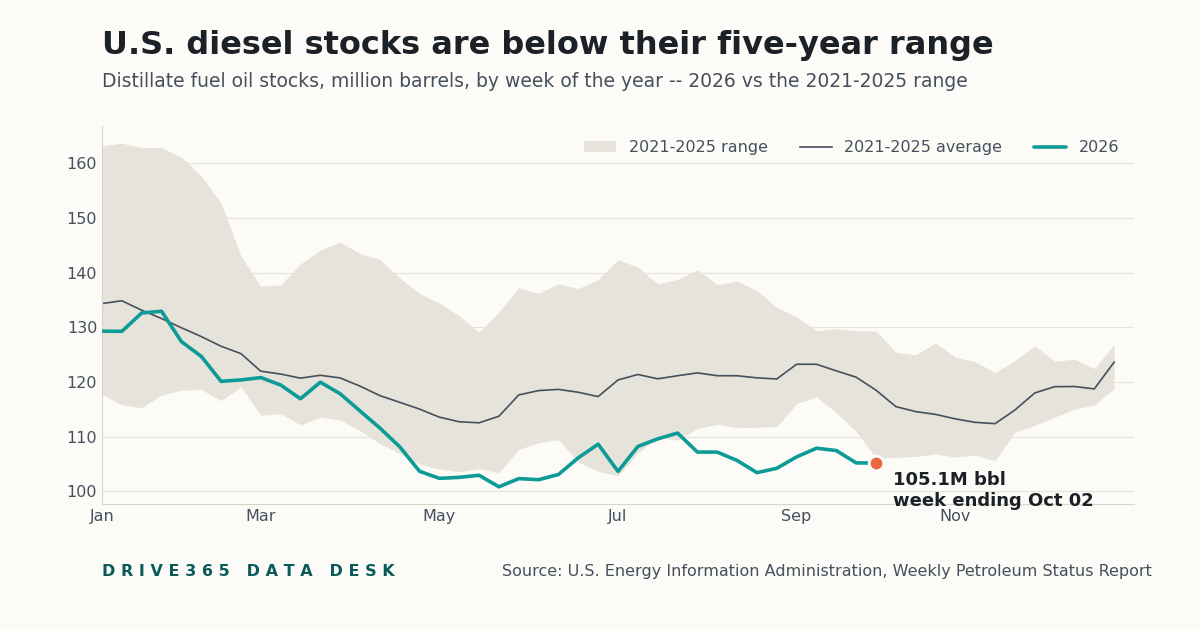
U.S. distillate stocks -- diesel and heating oil -- fell to 105.1 million barrels, below the lowest early October reading of the past five years (106.1 million barrels). Diesel averaged $6.199 a gallon at the pump. These are EIA's figures for the week ending October 02.
This week's fuel numbers
| This week | Week ago | Year ago | |
|---|---|---|---|
| Diesel, U.S. average retail ($/gal) | $6.199 | $6.382 | $3.711 |
| Distillate stocks (million bbl) | 105.1 | 105.2 | 121.6 |
| Days of supply | 28.8 | 26.6 | 28.0 |
| Refinery utilization (%) | 92.7 | 92.5 | 92.4 |
| NY Harbor diesel, wholesale ($/gal) | $4.871 | $4.955 | $2.342 |
| Brent crude ($/bbl) | $120.03 | $117.08 | $67.15 |
| Diesel crack ($/bbl) | $84.55 | $91.03 | $31.21 |
| Propane, Mont Belvieu ($/gal) | $0.878 | $0.860 | $0.699 |
| Ethanol production (thousand bbl/day) | 1,053 | 1,007 | 1,071 |
What the numbers measure
Distillate is the family of fuels refined from the middle of the crude barrel: on-road diesel, off-road farm diesel and heating oil. EIA counts them together because they come off the same units and compete for the same barrels -- a cold week in the Northeast and a busy week of harvest draw on one supply.
Days of supply divides those stocks by what the country used that week -- how long the cushion would last with nothing new coming in. The diesel crack is what a barrel of diesel sells for, wholesale in New York Harbor, over a barrel of Brent crude: the refiner's margin, and the plainest measure of how tight refining is.
Against the last five early Octobers
Over the past five years, U.S. distillate stocks in early October have run between 106.1 million barrels and 129.3 million barrels. This week's 105.1 million barrels is below the whole range. No early October in the 44 years of EIA's weekly record had less.
Also this week
- The U.S. average pump price of diesel moved 18 cents lower in a week, to $6.199 a gallon.
- Diesel at the pump is 67% higher than the same week last year ($3.711).
- Stocks cover 28.8 days of U.S. diesel demand, the thinnest early October cushion since 2025.
Who this helps and who it squeezes
| What this week's fuel numbers mean | |
|---|---|
| Trucking, farm and construction fuel buyers | Squeezes when diesel rises. Fuel is the largest cost that moves week to week. |
| Refiners | Helps when the crack widens. It is the refiner's margin on every barrel of diesel. |
| Soybean growers and crushers | Tends to help when diesel is high. Soybean oil is a feedstock for biodiesel and renewable diesel, which compete with diesel. |
Why an Iowan should care
This is harvest: combines, grain carts, the trucks to the elevator and the dryers behind them all run on these fuels, and nearly all of the year's fieldwork burns them in a few weeks. Iowa's farms, elevators and roads run on distillate, and every bushel that leaves the state moves on a truck first.
Sources: U.S. Energy Information Administration -- Weekly Petroleum Status Report (distillate stocks, product supplied, refinery utilization, ethanol production), week ending October 02, 2026; Gasoline and Diesel Fuel Update (U.S. No. 2 diesel retail average, October 05); spot prices for New York Harbor ultra-low sulfur diesel, Brent crude and Mont Belvieu propane. Days of supply and the diesel crack are arithmetic on those figures.
Compiled automatically by the Drive365 Data Desk from published EIA data. Generated 2026-10-08 16:30 UTC. This page reports published figures and the arithmetic on them. It does not forecast prices or offer trading or business advice.
 Brought to you byJensen TransportIowa freight and logistics.Visit jensentransport.com
Sponsorship supports the Data Desk. Sponsors have no input into what it reports; every figure above comes straight from the published source.
The Data Desk, weekly. One email every Saturday with the week's Data Desk numbers. Unsubscribe any time. Get the weekly email
Advertise on the Data Desk. Put your business in front of Iowa farmers, grain buyers and the companies that serve them, next to the numbers they read the day USDA releases them. Ask about sponsoring an article